
A Changing Landscape for IP Management Technology by Nick March


A Changing Landscape for IP Management Technology by Nick March, Chief Operating Officer at CedarIP, United Kingdom.
In the IP Tech & Innovation Services Annual, Nick March, Chief Operating Officer at CedarIP, United Kingdom, explores how modern IP management platforms are evolving to meet the increasingly complex demands of intellectual property professionals. As portfolios grow and organisations require greater visibility, automation, and flexibility, CedarIP has developed a platform designed to combine deep IP functionality with intuitive usability, connected data, and AI-assisted efficiency.
The Challenge Facing Modern IP Teams
Today's IP professionals operate across multiple jurisdictions, IP right types, stakeholders, and external partners. However, many organisations still rely on legacy systems that were not designed for the complexity of modern portfolio management. Outdated interfaces, rigid workflows, and limited reporting capabilities can create unnecessary administrative burdens and reduce operational efficiency.
As AI and automation continue to advance, organisations are increasingly seeking platforms that modernise IP management while maintaining the depth and reliability required for critical IP operations.
Built by IP Professionals for IP Professionals
CedarIP was developed with direct input from professionals experienced in patent administration, trade mark management, and IP operations. This practical expertise has shaped a platform designed to support patents, trade marks, and designs within a flexible framework that can adapt to different organisational requirements.
The company's approach also places strong emphasis on client feedback, ensuring the platform continues to evolve alongside the changing needs of the IP profession.
Prioritising Usability and Visibility
A key objective of CedarIP is reducing friction within complex IP workflows. One example is its intelligent search functionality, which enables users to locate information across the entire platform through field values, records, saved searches, and AI-powered natural language queries.
Combined with dynamic dashboard technology, users can create customised workspaces tailored to their specific responsibilities, providing greater visibility into deadlines, portfolio activity, reporting, and performance metrics.
Connected Data and Portfolio Intelligence
Modern IP management increasingly requires professionals to understand how different rights, matters, and activities interact across an organisation's portfolio. CedarIP addresses this through connected data visualisation tools that allow patents, trade marks, disputes, contracts, assignments, domains, and related matters to be linked and viewed together within interactive portfolio structures.
This broader perspective helps organisations move beyond simple record management and gain more strategic insight into their IP assets.
AI That Supports Rather Than Replaces Experts
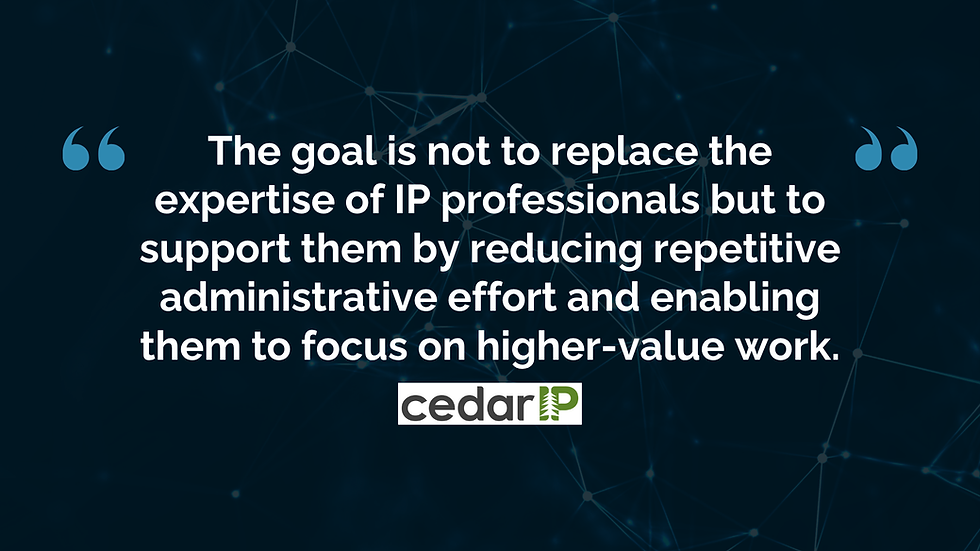
Nick March emphasises that CedarIP's approach to AI focuses on supporting professionals rather than replacing them. AI-assisted document processing and data extraction capabilities help streamline administrative tasks while ensuring experienced IP teams remain in control of decision-making and validation processes.
The objective is to reduce repetitive work, allowing professionals to focus more time on higher-value strategic activities.
Supporting Both Patent and Trade Mark Teams
Many IP management systems excel in either patent or trade mark management, but struggle to support both disciplines equally. CedarIP has been designed to provide a unified experience across all IP rights while maintaining the specialist functionality required for patent families, citations, IDS tracking, assignments, jurisdiction-specific workflows, and deadline management.
This allows organisations to manage diverse portfolios through a single platform without sacrificing depth or functionality.
A Partnership-Driven Approach
Beyond technology, CedarIP places significant emphasis on client support, onboarding, training, and long-term collaboration. The company also promotes open architecture, integration capabilities, and data ownership, enabling organisations to maintain flexibility and avoid long-term technology lock-in.
Conclusion
As IP portfolios become more complex and organisations demand greater efficiency, visibility, and flexibility, modern IP management platforms must evolve accordingly. Nick March demonstrates how CedarIP is combining usability, automation, connected data, and deep IP expertise to help organisations manage intellectual property more effectively in an increasingly technology-driven environment.
Read the full article in the inaugural edition of the IP Tech & Innovation Services Annual to explore how modern IP management technology is helping organisations improve efficiency, visibility, and control across increasingly complex intellectual property portfolios.


Comments